
How to Stop Nightfall: What Is Normal, What Is Not
If you are searching for how to stop nightfall, the honest medical answer is that you do not need to stop it. Nightfall is a normal bodily event, not a drain on your strength. You can reduce how often it happens, but removing it completely is neither necessary nor realistic.
The clinical term is nocturnal emission, an involuntary ejaculation that happens during sleep. A 2026 systematic scoping review published in Sexual Medicine Reviews examined 157 sources and found that nocturnal emissions occur in roughly 70 to 90 percent of men. Most men have their first between the ages of 12.6 and 15.6 years.
This guide covers what happens in the body, what the evidence says about normal frequency, and the specific signs that mean you should book an assessment.
Quick summary
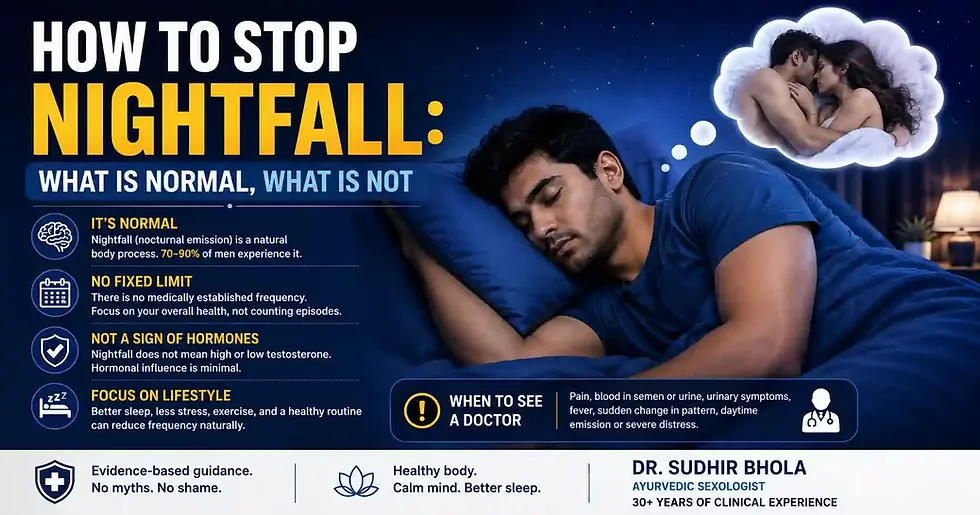
Nocturnal emission is an involuntary ejaculation during sleep. It is a normal physiological event.
It occurs in about 70 to 90 percent of men, according to a 2026 review of 157 sources.
Published data on how often it happens is scarce and inconsistent, so no weekly limit is medically established.
The idea that your body is clearing stored or excess semen is not supported by the evidence.
Hormonal influence on nocturnal emission is modest, so it does not signal high or low testosterone.
It happens with or without an erotic dream, because the reflex sits below conscious control.
Pain, urinary symptoms, or a clear change from your usual pattern deserve a proper assessment.
What nightfall actually is
Ejaculation is a spinal reflex. The nerves that coordinate it sit in the lower spinal cord, and they can fire without any instruction from the conscious brain. During sleep, blood flow to the genitals rises and falls in cycles, and the reflex threshold drops. When it is crossed, ejaculation follows.
The 2026 Sexual Medicine Reviews review found that nocturnal emissions happen with or without erotic dreams, and studies of men with spinal cord injury confirm the reflex can operate independently of higher brain control. A dream is a frequent companion to the event, not its cause.
How often is nightfall normal
There is no medically established limit, and this is the part most websites get wrong, which matters because many men arrive convinced they have crossed some line.
The 2026 Sexual Medicine Reviews review looked specifically at this question across 157 sources and concluded that data on frequency were scarce and inconsistent. The research needed to set a normal range has simply not been done well enough to set one.
You will still find specific thresholds quoted online, often phrased as three or four times a week. Those numbers are not drawn from published evidence. Some men experience nightfall a few times a month, others a few times a year, and others almost never. All of those patterns sit inside what is currently understood as normal.
What carries more meaning than a count is change. A stable pattern you have had for years is reassuring, while one that shifts sharply or arrives alongside other symptoms is worth investigating.
Does nightfall mean high or low testosterone
Neither. Frequent nightfall does not confirm high testosterone, and infrequent nightfall does not indicate low testosterone.
Men ask this in both directions, and popular articles answer it in both directions, which is why the confusion persists. The 2026 review assessed the hormonal contribution directly and found that hormonal, parental and prenatal influences appeared modest. Testosterone shapes libido and sexual development broadly. It does not act as a dial controlling how often you have a nocturnal emission.
If you have genuine symptoms of low testosterone, such as persistent fatigue, reduced morning erections, low mood or loss of muscle mass, those warrant a blood test, because counting nightfall episodes is not a substitute for one.
How to stop nightfall, what helps and what does not
Reducing frequency is a reasonable goal if the episodes disturb your sleep or distress you, but eliminating them is not a clinical target, and no treatment reliably achieves it.
Sleep quality and stress load are the levers with the most sensible rationale behind them. Consistent sleep timing, lower alcohol intake, regular exercise and less late-night sexual stimulation all address the arousal and sleep side of the equation.
Much of the rest of the standard advice list circulates because it is repeated, not because it has been tested. A 2026 review published in International Journal of Impotence Research found that medically unfounded claims about nocturnal emissions persist today, and that sexual medicine providers have a role in correcting them.
Commonly given advice | What the evidence actually shows |
Your body is clearing stored or excess semen | Not supported. The 2026 review found evidence did not support nocturnal emission as compensatory release when sexual outlet is low |
More than three or four times a week is abnormal | Not established. Published frequency data is scarce and inconsistent |
It means your testosterone is high | Not supported. Hormonal influence was found to be modest |
Avoid sleeping on your stomach | Untested. No published trial supports sleeping position as a control measure |
Empty your bladder before bed | Untested for this purpose, though sensible general practice |
Improve sleep and reduce stress | Reasonable. Addresses sleep quality and arousal, and carries wider health benefit |
How to stop nightfall during the day
Daytime emission, meaning semen appearing while awake without sexual activity, is a different matter and should not be managed with sleep advice. It may occur with straining at stool or with urination, and can point to a prostatic or pelvic floor issue that responds to treatment. Bring it to a clinician rather than treating it as ordinary nightfall.
Why nightfall can feel like weakness
The tiredness men report after nightfall is real, but the explanation for it is not semen loss.
Every ejaculation triggers a hormonal shift, including a rise in prolactin, which produces the familiar heaviness and reduced drive that follows. When this happens during sleep, it interrupts sleep architecture as well. You wake less rested, notice the fatigue, and connect it to the fluid rather than the broken sleep. Anxiety about the episode then disturbs the following night, and the cycle reinforces itself. We cover this mechanism at length in our article on whether ejaculation causes weakness.
Key takeaway: The fatigue attached to nightfall comes from disturbed sleep and the normal post-ejaculatory hormonal shift, not from losing something your body cannot replace. Semen is produced continuously, and the 2026 review found no support for the idea that emissions compensate for an unused reserve. Treating the sleep disruption and the anxiety usually resolves the tiredness that brought men to search in the first place.
When frequent nightfall points to something treatable
Nightfall itself is not a disease, though it can sit alongside conditions that respond well to treatment, and those are worth ruling out.
You should see a doctor if any of the following apply. Pain during or after the episode. Blood in the semen or urine. Burning, urgency or difficulty passing urine. Fever or pelvic discomfort.
A sudden change from a pattern you have had for years. Emission during the day, particularly with straining. Or distress heavy enough to affect your sleep, work or relationship.
One cause is routinely missed: medication. The 2026 review queried international drug safety databases and identified medication-associated nocturnal emissions. If your pattern changed after starting or stopping a drug, tell your doctor and take the packaging with you.
Persistent anxiety about semen loss has a recognised clinical shape in South Asia. The same review noted misconceptions remain widespread in this region, where nocturnal emission is central to dhat syndrome, a distinct presentation from nightfall itself that we cover in why semen-loss anxiety is so common in India.
What I see in my clinic
In my clinical practice, the pattern is consistent enough to describe. Men rarely arrive because of the emissions themselves, but because of what they have read about them.
A typical case at Curewell Therapies is a man in his twenties who has counted episodes for months against a threshold he found online, and sleeps badly because of it. Examination and basic tests are frequently normal, and what changes his symptoms is not a formulation but an accurate explanation, a review of his sleep, and ruling out the conditions that genuinely need attention.
Where tests do show something, it is usually treatable, which is the argument for examination rather than for worry.
Frequently asked questions
How to stop nightfall without taking medicine?
No medicine is required, because nightfall is not a disease. Better sleep timing, less alcohol, regular exercise and reduced late-night sexual stimulation can lower how often it happens. Products marketed to stop it permanently have no published evidence behind that claim, so treat them with caution.
Does nightfall mean low testosterone?
No. Nightfall frequency does not indicate your testosterone level in either direction. The 2026 Sexual Medicine Reviews analysis found hormonal influence on nocturnal emission to be modest. If you have fatigue, low mood or reduced morning erections, ask for a blood test instead of counting episodes.
Is daily nightfall good or bad?
Daily episodes are unusual but not automatically harmful. Because published frequency data is scarce, no number defines abnormal on its own. What matters more is whether the pattern changed suddenly and whether other symptoms accompany it, such as pain, urinary trouble or disturbed sleep.
Why does nightfall happen without any dream?
Because the ejaculatory reflex sits in the spinal cord, below conscious control. The 2026 review confirmed nocturnal emissions occur with and without erotic dreams. Research on men with spinal cord injury shows the reflex can operate without input from the brain, so a dream is not required.
Can a medication I am taking cause nightfall?
Yes, some medications are associated with it. The 2026 review searched international drug safety databases and identified medication-linked nocturnal emissions. If your pattern changed after a new prescription or a dose change, mention it to your doctor and bring the packaging rather than stopping the drug yourself.
What should I do right after nightfall happens?
Nothing medical is needed, so wash, change your clothing and go back to sleep. No food, supplement or ritual is required to recover, because nothing has been lost that your body does not continuously replace. Treating it as an emergency tends to worsen the sleep disturbance around it.
Does nightfall get less frequent as I get older?
For most men it does become less frequent after the late twenties. The pattern varies widely between individuals, and published data on frequency across age groups remains limited. A gradual decline is expected. A sudden change at any age is worth mentioning to your doctor.
References
Maiolino G, Fernandez-Pascual E, Lledo-Garcia E, Martinez-Salamanca JI. Nocturnal emissions or wet dreams: modern evidence from a systematic scoping review. Sexual Medicine Reviews. 2026 Jan 2;14(1):qeag003. https://doi.org/10.1093/sxmrev/qeag003
Rabil MJ, Cahill EM, Honig SC. It Comes at Night: A Nocturnal Emissions Historical Review. International Journal of Impotence Research. 2026 Jun 26. https://doi.org/10.1038/s41443-026-01310-y
Strong YN, Li A, White ME, Razzak AN, Anderson DJ, Kaye AD, Herron EW, Khater NP, Bradley EC, Urits I. Dhat Syndrome: Epidemiology, Risk Factors, Comorbidities, Diagnosis, Treatment, and Management. Health Psychology Research. 2022 Oct 13;10(4):38759. https://doi.org/10.52965/001c.38759
Gul A, Yuruk E, Serefoglu EC. Frequency of nocturnal emissions and masturbation habits among virgin male religious teenagers. Revista Internacional de Andrologia. 2020 Jan-Mar;18(1):21-26. Adolescent sample, cited here only for the finding that emissions were unrelated to time since last ejaculation. https://doi.org/10.1016/j.androl.2018.08.002
Dr. Sudhir Bhola is an Experienced Ayurvedic Sexologist in India, Founder of Curewell Therapies. He is a member of ISSM, ESSM, AASECT and NAMA, with more than 30 years of clinical experience treating men's sexual health conditions. He practises across clinics in Delhi NCR and sees patients nationally and internationally.


